
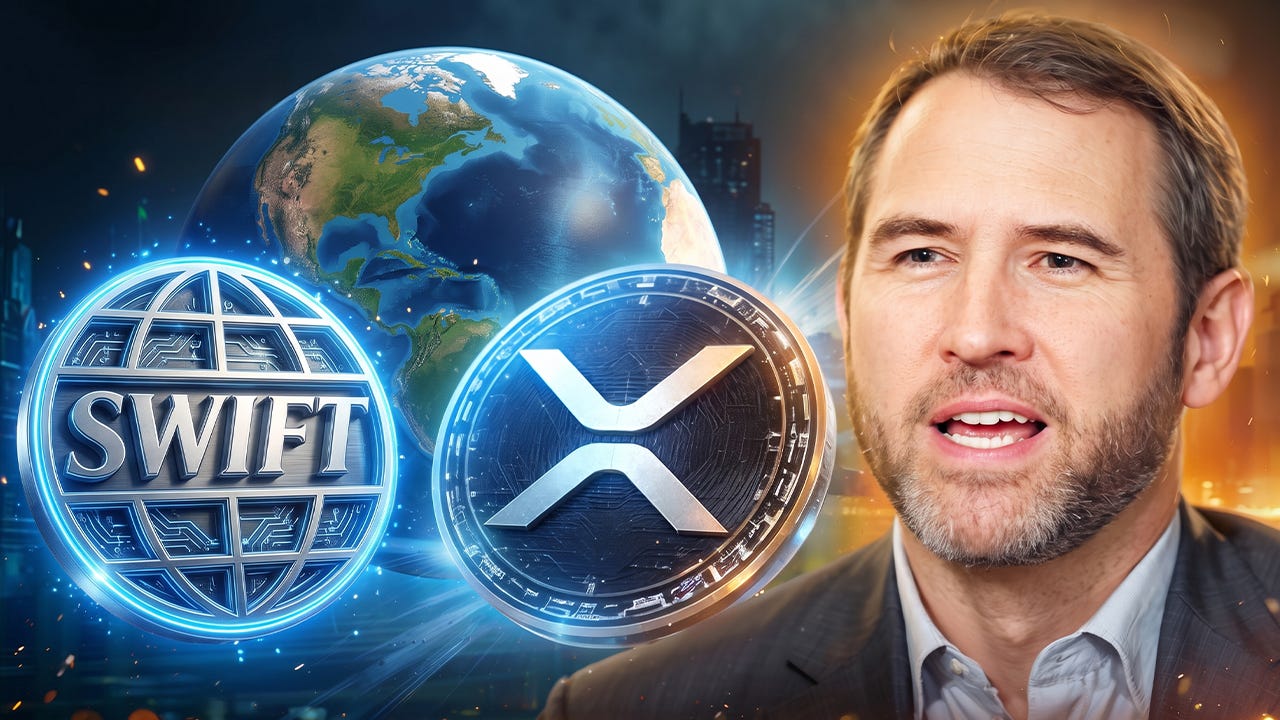
For years, the debate around Ripple and SWIFT was framed as a battle for dominance in cross-border payments.
Subscribe for Breaking XRP News and Premium Price Analysis
Ripple executives openly spoke about replacing the decades-old banking network, while supporters of XRP viewed the digital asset as the future of international settlements. That narrative has changed significantly.

Today, the discussion is no longer centred on whether Ripple will replace SWIFT.
Instead, the focus has shifted to a more complex reality where the two systems are becoming increasingly connected, even as they continue to develop separate technologies.
The result is a unique paradox. XRP is not part of SWIFT’s new blockchain infrastructure, yet it can still play a role in transactions that move through the global banking network.
SWIFT leaves XRP outside its shared ledger
SWIFT remains the dominant messaging network for cross-border payments.
More than 11,500 financial institutions across over 200 countries and territories rely on its infrastructure to exchange payment instructions every day.
According to SWIFT, the network processes tens of millions of financial messages daily, making it one of the most critical components of the global financial system.
Rather than standing still as blockchain technology gained traction, SWIFT invested heavily in modernising its own infrastructure.
One of its biggest milestones has been the transition to ISO 20022, a global financial messaging standard designed to improve payment data quality and interoperability.
The organisation has also been developing a permissioned shared ledger to support tokenised assets and digital transactions between financial institutions.
The platform is designed to connect banks and regulated financial entities without requiring them to abandon existing payment rails.
According to Swift, 34 banks have committed to going live with the Swift payments scheme by the end of June.


Notably, XRP is not part of this shared ledger.
SWIFT’s architecture does not require the digital asset for settlement, nor has the organisation announced plans to integrate XRP directly into the platform.
At first glance, that appears to weaken XRP’s role in institutional finance. However, the broader payments ecosystem tells a different story.
Ripple shifts from competition to integration
Ripple’s strategy has evolved considerably over the past decade.
Earlier public statements from Ripple CEO Brad Garlinghouse often positioned the company as a challenger to SWIFT.
More recently, Ripple has focused on working alongside existing financial infrastructure instead of replacing it.
This strategic shift is reflected in the company’s expanding product portfolio.
Beyond XRP-powered payments, Ripple has introduced institutional custody services and launched RLUSD, a US dollar-backed stablecoin aimed at regulated financial institutions.
The company has also continued developing Ripple Payments, which gives financial institutions multiple settlement options depending on their liquidity needs and regulatory requirements.
That means XRP has become one option within a broader payments ecosystem instead of serving as the only settlement asset available through Ripple’s network.
XRP can still connect to the SWIFT ecosystem
Although XRP is excluded from SWIFT’s shared ledger, it is not completely separated from the SWIFT ecosystem.
A key example is Ripple’s partnership with Thunes, a global cross-border payments provider that operates one of the world’s largest payout networks.
Through this relationship, Ripple’s On-Demand Liquidity technology can be used to facilitate cross-border settlements while remaining connected to existing banking infrastructure.
This distinction is important.
SWIFT primarily functions as a messaging network that instructs financial institutions how payments should move.
Settlement, however, often occurs through correspondent banking relationships that require banks to maintain pre-funded nostro and vostro accounts across multiple jurisdictions.
Ripple’s On-Demand Liquidity was designed to reduce that requirement by using XRP as a temporary bridge asset.
Instead of locking capital in foreign accounts, participating institutions can source liquidity when the payment is initiated, complete the transfer within seconds, and convert back into the destination currency.
This process does not require SWIFT to adopt XRP directly. Instead, XRP can operate alongside existing banking rails when institutions choose that settlement option.
That creates an unusual relationship. SWIFT continues to provide the global financial messaging infrastructure, while Ripple offers an alternative settlement mechanism that can complement traditional payment flows.
Never miss any XRP News or Price Analysis
Subscribe Now