

Ripple has taken a notable step forward in its European expansion strategy after securing preliminary approval under the European Union’s Markets in Crypto-Assets (MiCA) framework through Luxembourg’s financial regulator, the Commission de Surveillance du Secteur Financier (CSSF).
To Stay Ahead of the XRP News, Subscribe Below Before the 50% Offer Ends
The preliminary approval places the company closer to offering regulated crypto and payments services across the European Economic Area, although the approval remains conditional and not final.
Luxembourg approval makes Ripple compliant to operate in the EU
The CSSF’s preliminary approval signals that Ripple’s operational structure in Luxembourg is moving in line with MiCA requirements, particularly those governing Crypto-Asset Service Providers (CASPs) and electronic money institutions that support stablecoin-related services.
Under MiCA rules, firms must first establish a compliant legal entity within an EU member state before they can offer services across all 30 European Economic Area countries, including the 27 EU member states, along with Iceland, Norway, and Liechtenstein.
Ripple’s Luxembourg base is designed to support this framework, allowing the company to scale services once final authorisation is granted.
The approval is also tied to Ripple’s broader licensing efforts in Europe, including its earlier progress toward electronic money institution authorisation in Luxembourg.
That license is typically required for companies that intend to issue or manage euro- or dollar-pegged digital assets within the EU regulatory perimeter.
Ripple targets EU with its cross-border payments infrastructure
Ripple’s European strategy is closely linked to the expansion of its cross-border payments infrastructure, known as Ripple Payments.
The company has been steadily building regulatory access in key financial jurisdictions, with Europe seen as a critical region for institutional settlement flows.
The Luxembourg approval strengthens Ripple’s positioning to support regulated payment corridors across Europe once final clearance is obtained.
It also supports the company’s broader stablecoin ambitions, including the rollout of its dollar-backed stablecoin RLUSD, which is designed to operate within compliant regulatory frameworks in major markets.
XRP weakens despite regulatory progress
Despite the regulatory development, XRP traded at $1.10, reflecting a 4.4% decline over the past 24 hours.
Over the past seven days, the token has fallen 10.6%, while the 30-day decline stands at 19.4%. On a longer horizon, XRP is down approximately 46% over the past year.
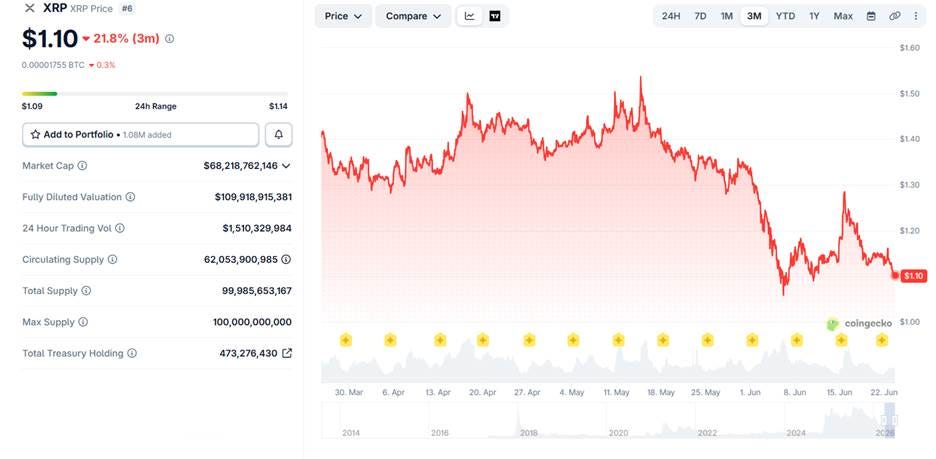
During the same session, XRP moved within a 24-hour range of $1.09 to $1.14, showing limited intraday recovery despite the headlines surrounding Ripple’s regulatory progress in Europe.
Trading volume over the past 24 hours reached roughly $1.51 billion, indicating continued active participation from market participants even as price momentum remained weak.
The broader trend shows sustained selling pressure that has persisted even through multiple regulatory and institutional developments.
XRP also remains significantly below its all-time high of $3.65 recorded in July 2025, placing current prices nearly 70% lower than peak levels.
Why didn’t the news lift XRP’s sentiment?
The lack of positive price reaction suggests that traders are currently prioritising broader market structure over regulatory headlines.
XRP has repeatedly failed to hold upward momentum despite policy-related developments, and the latest MiCA milestone followed a similar pattern.
From a technical perspective, XRP is trading in a compressed range between $1.09 and $1.14 in the short term.
A break below $1.09 would place immediate focus on the $1.05 support area, which has acted as a short-term floor in recent sessions.
If selling pressure continues beyond that level, traders are watching $1.00 as a psychological support zone that has historically attracted liquidity.
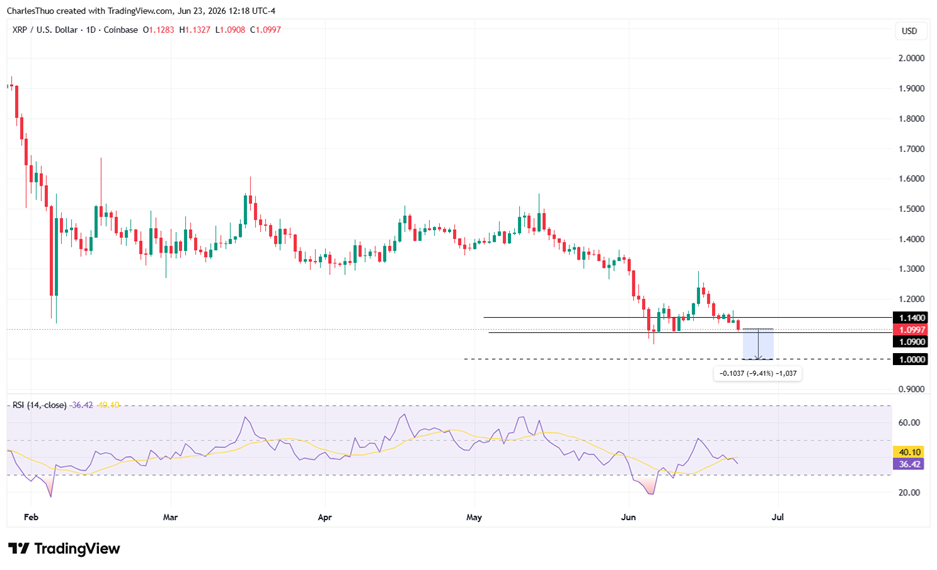
On the upside, recovery attempts are likely to face resistance near $1.14, which aligns with the upper boundary of the current 24-hour range.
A sustained move above this level would be needed to shift short-term momentum, with $1.20 emerging as the next area of interest based on recent trading structure.
For now, XRP remains heavily influenced by broader risk sentiment and liquidity conditions rather than isolated regulatory developments.
The divergence between Ripple’s regulatory progress in Europe and XRP’s price performance highlights a market still driven by macro pressure and cautious trading behaviour.
Don’t Miss Any XRP Price Analysis; Subscribe Now and Get 50% Off